



Justin
Stephens
I'm a divorced dad of three, working my way up from night stocker to founder — building a company that gives ordinary people a real stake in something that matters. I talk about ownership, rebuilding, and making America work for the people who show up every day.
Read my story

Latest writing
What I'm thinking about right now.
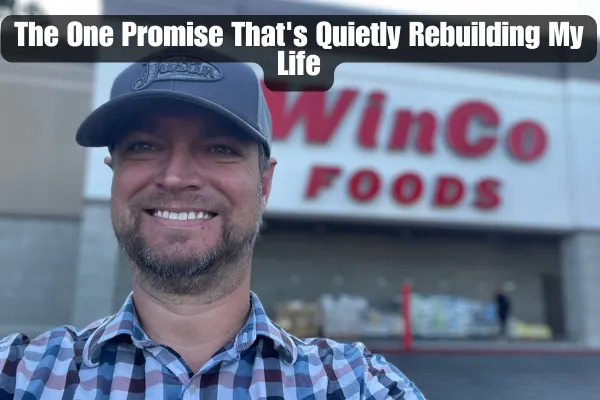
I Made One Promise to Myself About Posting Online. It's Quietly Rebuilding Everything.
I Made One Promise to Myself About Posting Online. It's Quietly Rebuilding Everything.
Part 3 of The Ownership Mindset series. Start with the manifesto →
The bankruptcy nobody tells you about
There's a kind of bankruptcy that doesn't show up on your credit report.
You go bankrupt with yourself.
It happens slowly, then all at once. You promise yourself you'll wake up at 5. You sleep till 7. You promise yourself you'll quit drinking on weekdays. You don't. You promise yourself this is the year you start the business. The year passes. You promise yourself you'll text her back, hit the gym, call your dad, finish the book, fix the thing in the garage, finally have the hard conversation. Some of it gets done. Most of it doesn't.
Each broken promise is a small withdrawal from one specific account: your belief that you can be trusted. Make enough withdrawals and you go bankrupt. And once you're internally bankrupt, you stop even bothering to make promises, because some part of you already knows you won't keep them.
That's the worst part. Not the broken promises. The fact that you eventually stop making them at all. You start identifying as the kind of person who can't — can't quit drinking, can't get up early, can't follow through, can't stick with anything. You build a personality around the bankruptcy and call it self-awareness.
I lived in that bankruptcy for most of my thirties. Let me tell you about the small, weird thing that started to pull me out.
The promise
A few months ago, I made myself one promise.
Post something every day. On every platform. Whether it's good or not. Whether I want to or not. Just post.
That's it. That was the entire promise. TikTok, X, Instagram, YouTube, Facebook — every day, something goes up. The bar isn't good. The bar isn't viral. The bar is posted.
I want to tell you I started this because I had a content strategy. I didn't. I started it because I was tired of being the guy who'd been "about to start posting" for three years.
I'd had social accounts for a long time. Plans for what I was going to put on them. Notes saved in my phone for video ideas I never recorded. Drafts of posts I never published. The accounts existed. The posting didn't. Somewhere in there I'd quietly accepted that I was the kind of guy who thought about building an audience but never actually did the thing.
Some part of me knew that was a lie I couldn't keep telling myself forever. The lie had been building for a while — every time I scrolled past someone less talented than me actually posting, every time I watched another month go by with my drafts folder full and my feed empty, every time I told someone "yeah I'm working on it" and meant no I'm not.
It built up gradually until one day it tipped. Not a lightning bolt. Just a quiet realization that the version of myself I was waiting to become — the more polished, more confident, more "ready" version — was never going to show up if I didn't start posting as the unpolished, unsure, unready version I currently was.
So I made the promise. Post every day. On everything. Quality optional. Showing up mandatory.
What I was actually afraid of
I want to be honest about the blocker, because if you have one, it's probably the same one I had.
I wasn't blocked because I had nothing to say. I have plenty to say. I'm a former Sandler trainer with a marketing degree, three failed businesses, a divorce, three kids, and a manager-in-training job at a grocery store. I have things to say.
I was blocked because I was afraid of what people would think.
Specifically: people who knew me from before. The entrepreneur friends who watched me launch the businesses that didn't make it. The college friends who'd seen me at my most confident. The clients I used to coach. The ex's family. People I went to high school with in Boise. The whole audience of people who already had a version of me in their head and might judge whatever new version I started showing them.
What if my videos were cringe? What if I sounded preachy? What if I posted something earnest and somebody screenshotted it to a group chat? What if the night-shift-freight guy had no business talking about ownership and ambition? What if I was too much? What if I was not enough? What if posting daily made me look desperate? What if posting daily made me look unfocused? What if, what if, what if.
Every one of those questions had been keeping me silent for three years.
The promise didn't make any of those questions go away. The promise just made them irrelevant. Post anyway was the rule. The rule didn't care how I felt about the rule.
What's actually happened
I'm a couple of months in. I want to tell you what's true so far, not to brag, but because the truth is way more boring than the fear, and I think the boringness is the point.
Some posts have flopped. A few have gotten almost no engagement. Like, embarrassingly little. The kind of low numbers that, six months ago, would have validated my whole "maybe I'm not built for this" story and given me an excuse to quietly stop.
Nothing terrible has happened. Nobody from my old life has dunked on me publicly. Nobody has screenshotted anything to mock it. The disasters I was rehearsing in my head have not occurred. The cringe police did not show up. Most of what I was afraid of was a movie I was directing in my own anxiety, not a thing that was going to happen in the world.
I've gotten noticeably better at it. This is the part I didn't expect. The me who's posting now is a different guy than the me who pressed publish on the first one. I'm faster. I'm more natural on camera. I write tighter. I edit less. I press publish without my stomach turning over. Some of the videos I'm making now would have been impossible for me eight weeks ago — not because I didn't have the skill, but because I didn't have the reps. The reps were the unlock the whole time.
My internal account is filling back up. This is the real product. Not the followers. Not the engagement metrics. The fact that every night, when I go to bed, I can honestly answer the question did you do today what you said you'd do? with a yes. And the next morning I'm a slightly different guy than I was the morning before — a guy with a tiny but real piece of evidence that he can be trusted.
That feeling — the quiet certainty that I do what I said I'd do — is something I hadn't felt in years. Maybe a decade. The promise gave it back to me. The pile of mediocre content is what produced it.
Why this works (and why most "discipline" content doesn't)
Most content about discipline is selling you a version of yourself you can't yet afford.
Wake up at 5. Cold plunge. Two-hour workout. Read 30 pages. Journal. Meditate. Hit your protein. Build the brand. Crush your day. Win.
If you're internally bankrupt, you can't do any of that. Not because you're weak — because you don't have the trust capital to spend on a stack that big yet. You're trying to invest a hundred dollars when your balance is twelve. The plan fails by Wednesday and you call it another data point on why you "just can't follow through."
You don't have a follow-through problem. You have a capital problem. You're broke, internally. You need to make tiny deposits until the balance is large enough to afford bigger withdrawals.
The post-every-day promise works because the bar is so low that I literally can't justify breaking it. Some days I post a 30-second video I shot in my truck on the way home. Some days I write a single paragraph on X. Some days I share a photo with one line of caption. None of it is high art. All of it counts. The bar isn't good. The bar is posted.
That's the trick. The promise has to be small enough to be unbreakable. Whatever you're trying to rebuild trust around — health, work, your word with people you love, anything — the rule is the same: make the promise so small that breaking it would be more humiliating than keeping it.
Compound from there.
The rules I follow now
A couple months into this experiment, here's what I've learned. None of it is original. All of it is non-negotiable for me now.
Promises stay small until the balance grows. The bar is posted, not good. If I raised the bar to "post something good every day," I'd fail by week two and the bankruptcy would deepen. The size of the promise doesn't matter. The kept-ness of the promise is everything.
A kept promise compounds. A broken one doesn't just zero out — it goes negative. This is the asymmetry nobody talks about. Keeping a promise gives you +1. Breaking one gives you -3. One broken day can undo two weeks of kept ones, because once you've broken one you start asking yourself what's the point. So I don't break it. Even on the days when posting feels pointless, I post — because the pointlessness is the test. Posting through it is the whole exercise.
Public promises and private promises are different accounts. A promise you make to yourself, in your head, that nobody else knows about — that's the most important account, and it's the one most guys are bankrupt in. The posting commitment is technically public (everyone can see if I posted), but the promise is private. Nobody knows on a given day whether I felt like quitting. Nobody knows whether I almost didn't. The contract is between me and me.
The fear is the content. This is the weird one. Some of my best-performing posts have been the ones I almost didn't publish because I thought they were too vulnerable, too earnest, too embarrassing. The thing I was afraid would be cringe was the thing that landed. The fear was a signal, not a stop sign.
Speak less about what you're going to do. Just do it and let people notice. I stopped announcing my "content strategy" to friends and family. I just started posting. The bankruptcy was partly a function of how much I'd announced over the years that never materialized. Cutting the announcements cut the bleed.
Where this connects to everything else
Here's why this matters beyond posting online.
Your word is the substrate everything in your life is built on. Your relationships are made of kept promises. Your career is made of kept promises. Your reputation is made of kept promises. Your self-image — the most important one — is made of kept promises.
If your word is good, you can build anything. If your word is bad, you can't build anything that lasts. You can fake it for a while, with charm or hustle or talent, but eventually the structure collapses because the foundation isn't there.
This is true at the level of stocking freight ("I said I'd be on time at 10, I was on time at 10"), and it's true at the level of running a country. What I'm slowly learning is that the entire game of life is played on the field of kept promises. The size of the promise barely matters. The keeping is the thing.
The posting commitment isn't really about social media. The posting is the cover story. The real product is the trust I'm rebuilding with the only person whose opinion of me determines what I'm capable of next: me.
What I want you to take from this
If you're internally bankrupt — if you've made and broken so many promises to yourself that you don't even bother making them anymore — I am telling you, from inside the experiment: you can rebuild this. It's not fast. It's not glamorous. It's not a 75-day challenge with a hashtag.
Pick something small enough that breaking it would be embarrassing. Drink water before coffee. Make your bed. Send one outreach message a day. Post one thing a day, even if it's mediocre. Whatever it is, make it so small that you have no rational excuse for not doing it. Then make sure quality is not part of the bar. The bar is did you do the thing.
Do it. Quietly. Don't announce it. Don't track it on a spreadsheet. Don't post about the practice. Just do the practice itself, and notice — without forcing it — how the account starts to fill back up.
A couple months from now you'll feel something you've forgotten the taste of: the quiet certainty that you can be trusted to do what you said you'd do.
That feeling is the foundation everything else gets built on.
The posts are not the point. The posts are the entry point.
Last in the series: the three failed businesses that taught me why I bet on an ESOP. → Read part 4
Or go back and start with the manifesto.
Follow along on X and YouTube — and yeah, you can watch me keep the promise in real time.

What I'm building
America's Holding Company
Ownership for everyone
who shows up
Most people spend their whole life paying into things they'll never own. I built the opposite of that. Twenty-seven dollars a month. A Christmas ornament. And real ownership that grows every year you stay.
Learn about AHC →Letters from the ladder
Real talk on ownership, rebuilding, and building something worth leaving behind. No fluff. Just what I'm actually learning — sent straight to your inbox.
America's Holding Company Inc.