

Justin
Stephens
I'm a divorced dad of three, working my way up from night stocker to founder — building a company that gives ordinary people a real stake in something that matters. I talk about ownership, rebuilding, and making America work for the people who show up every day.
Read my story

Latest writing
What I'm thinking about right now.
Three Failed Businesses Taught Me Why I Bet on an ESOP Instead
Three Failed Businesses Taught Me Why I Bet on an ESOP Instead
Part 4 of The Ownership Mindset series. Start with the manifesto →
The years nobody puts on a LinkedIn profile
Between 2018 and 2023, I started three businesses.
None of them are around anymore.
I'm not going to walk you through every detail of each one — that's three separate posts — but I'll tell you what they had in common: I was the founder, I was carrying most of the risk, I was making most of the decisions, and I owned a hundred percent of the outcome. Which sounded great on the front end. Pure ownership. Total upside. Captain of my own ship.
What it actually meant on the back end was that when each one didn't work, I owned a hundred percent of the loss. Financial. Emotional. Reputational. There was nobody else to share it with. Nothing to soften the landing.
By the time the last one wound down, I was in my late thirties, divorced, and looking at a starting line I thought I'd left behind a decade earlier. I had to take an honest look at how I'd been thinking about ownership and figure out what was wrong with it.
Because here's the thing nobody tells you when you're 24 and reading entrepreneurship Twitter: most founder stories you read are survivorship bias wearing a cape. For every guy who built the thing and made it work, there are 10 to 50 guys who made similar bets and didn't. Those guys don't write threads. Their stories don't trend. But statistically, they're you and they're me.
I'd been worshipping the wrong kind of ownership. Let me tell you what I mean.
The ownership myth most guys are sold
The cultural script for an ambitious 25-year-old man right now goes something like this:
Don't work for someone else. That's a sucker's bet. Build your own thing. Own a hundred percent of it. Stay lean. Don't take investment unless you have to. The end state is being a founder.
There's a version of this that's true. There are situations where founding the company is the right call. There are people built to handle that level of risk and autonomy. There are markets where being a founder is the only way to access the upside.
But there's a version of it that's a lie, and it's the version that gets the most retweets. The lie is that being a founder is the highest form of ownership available to a working person. It isn't. It's one form of ownership. And for most people, most of the time, it's not the smartest one.
I learned this the hard way. Three times.
What "ownership" actually means
Let me get specific. When people use the word "ownership," they usually mean one of three different things, and conflating them is what messes most of us up.
Ownership of a thing you built from zero. This is what most founders mean. You created it, you legally own the equity, you can sell it or shut it down. The upside is theoretically uncapped. The downside is that you carry all the risk, you're responsible for every problem, and the failure rate is ugly. Most small businesses don't make it five years. Most that do make it five years don't make it ten. The math is brutal and the survivors don't talk about it.
Ownership of a piece of something other people built. This is what investors do, what employees with stock options do, what ESOP members do. You contribute capital — money, labor, time — and in exchange you get a stake. The stake is smaller than full ownership, but the risk is also smaller, and the system is structured so the people who actually built and ran the thing are aligned with you on the outcome. Returns aren't lottery tickets. They're spreadsheets.
Ownership of yourself. This is the foundation, and it's free. It's the stuff we covered in the first three posts of this series — owning your time, your word, your choices. Without this one, the other two don't work, no matter which structure you pick.
Here's where most ambitious 25-year-olds go wrong: they assume ownership #1 is the goal and ownership #2 is for people who couldn't hack it. They're inverted. Ownership #1 is the highest-risk version. Ownership #2 is, statistically, the higher-return version for most people — because the failure rate is dramatically lower and the upside is real.
I had to fail three times to figure that out.
What changed at WinCo
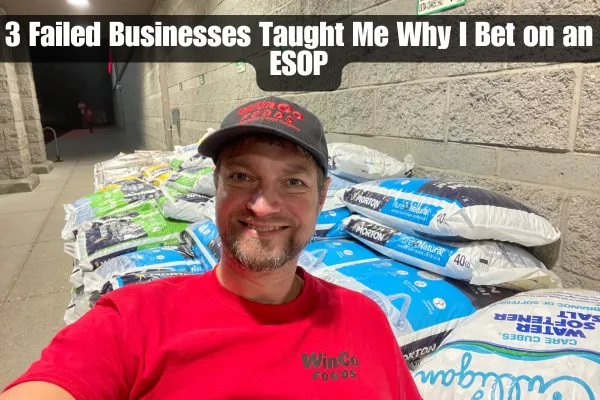
I work at WinCo Foods now. WinCo is one of the largest employee-owned grocery chains in America. The structure is called an ESOP — an Employee Stock Ownership Plan. The short version is this: a portion of every paycheck I earn gets translated into shares of the company I'm working for. The longer I stay, the more I own. When I retire, I get bought out at the company's share price at that time. WinCo employees who stayed twenty or thirty years have retired with $700,000, $1 million, even more — as cashiers and stockers.
Read that again. Cashiers and stockers, retiring as millionaires. Not because they were brilliant founders. Because they showed up to a structure that translated time into ownership and they let it compound.
When I learned the math on it, something snapped into place for me. I'd spent ten years chasing a kind of ownership that ate me alive three times. Meanwhile there was a structure sitting right there — visible in my own community, employing thousands of people in Idaho — that turned a working-class job into generational wealth. Quietly. Reliably. Without a podcast.
I had been trained, by entrepreneur culture, to look down on this kind of ownership. Just a job, the culture says. Real men build their own thing.
Real men, it turns out, sometimes build their own thing AND lose three times AND wind up broke at 38 with three kids to feed. The "just a job" guy at the next checkout aisle is on track to retire with a million dollars.
Who's the sucker?
The honest version of "ownership beats employment"
I want to be careful here, because the title of the pillar is Ownership Beats Employment, and I don't want you to misread what that means now that I've told you all this.
It does not mean: quit your job and start a business.
It means: stop trading your hours for an outcome you don't get a piece of.
Those are two completely different statements. The first is the entrepreneur-Twitter version. The second is the actual principle.
If you're working at a company that gives you no equity, no profit-sharing, no path to ownership — yeah, that's a problem worth solving. But the solution isn't necessarily to start your own thing. The solution might be to find an employer who offers an ESOP, a profit-share, an equity track. The solution might be to negotiate for shares instead of just salary at your next job. The solution might be to build a small side business that you fully own, while keeping the day job that's slowly making you an owner of that company too. (That's basically what I'm doing right now.)
The point is the piece of the outcome. Not the org chart.
The bet I'm making now
So here's where I am, and where I'm betting.
I work at WinCo, where I'm a Variety Manager in Training and earning equity in a company that turns hourly workers into millionaires. That's bet number one — a structural one, low-risk, decades-long.
I run America's Holding Company, a small thing I founded that lets subscribers earn ownership through a Christmas ornament subscription. That's bet number two — an entrepreneurial one, higher-risk, fully owned by me.
And I'm building this personal brand — the writing, the content, the community — which is bet number three, on myself.
Three bets, three different ownership structures, all stacked. If I'd known what I know now at 28, I would have built this stack a decade ago instead of going all-in on three founder bets in a row.
The lesson I'd give to a younger guy reading this: stack your ownership. Don't bet it all on one form. A boring ESOP job. A small thing of your own that you own outright. A skill or brand or audience that compounds in your own name. Three different kinds of ownership, all working at once, all hedging each other.
That's the version of "ownership beats employment" that actually works. Not the version that has you eating ramen at 38 because you bet everything on one founder swing. The version where five years from now, regardless of what happens to any one of those three bets, you're more of an owner than you were when you started.
The bigger thing this points to
I'm going to leave you with a thought, and we'll come back to it in future writing.
If ESOPs work this well at the level of a single grocery company — turning regular working people into millionaires by giving them a piece of what they're building — there's a question worth asking about why that structure stops at the company level.
Why don't citizens own a piece of what their tax dollars build? Why isn't the relationship between Americans and the things they fund structured the same way the relationship between WinCo workers and their company is?
I think it should be. I think there's a serious idea hiding in that question. But that's not this post. That's a much bigger conversation, and you and I need to know each other better before we have it.
For now, the practical takeaway is simple: stop chasing the kind of ownership that's going to chew you up. Start building the kind that compounds while you sleep.
A piece of something is better than a hundred percent of nothing. Ask me how I know.
That's the four-part series. If you read all four, thank you. You now have the full operating system.
Go back to the manifesto any time you need to reset. And follow along on X or YouTube for what comes next — because this was the foundation, not the finish line.

What I'm building
America's Holding Company
Ownership for everyone
who shows up
Most people spend their whole life paying into things they'll never own. I built the opposite of that. Twenty-seven dollars a month. A Christmas ornament. And real ownership that grows every year you stay.
Learn about AHC →Letters from the ladder
Real talk on ownership, rebuilding, and building something worth leaving behind. No fluff. Just what I'm actually learning — sent straight to your inbox.
America's Holding Company Inc.